
Agentic Commerce Gains Ground: 96% of Retailers Have Already Invested in AI
Reading Time: 2 minutes A new industry study shows that agentic commerce is moving from…

Running short of time? Get PDF of the blog in your mail.
Print on demand on Etsy is no longer a low-effort side hustle. In the new year, it is a systems-driven business model where success depends on strong Etsy SEO 2026, profitable pricing, reliable fulfillment, scalable operations, compliant practices, and consistent marketing.
The barrier to entry is still low, but the barrier to sustained growth is higher than ever.
Etsy has evolved:
Unlike surface-level advice, this guide focuses on:
Let’s start with the foundation that determines everything else: Etsy SEO in 2026. For a complete step-by-step foundation (from setup to first sales) refer back to the main Etsy POD pillar guide.
How SEO works on Etsy in 2026has changed materially. The marketplace now prioritizes buyer intent, behavioral signals, and mobile-first usability over raw keyword stuffing.
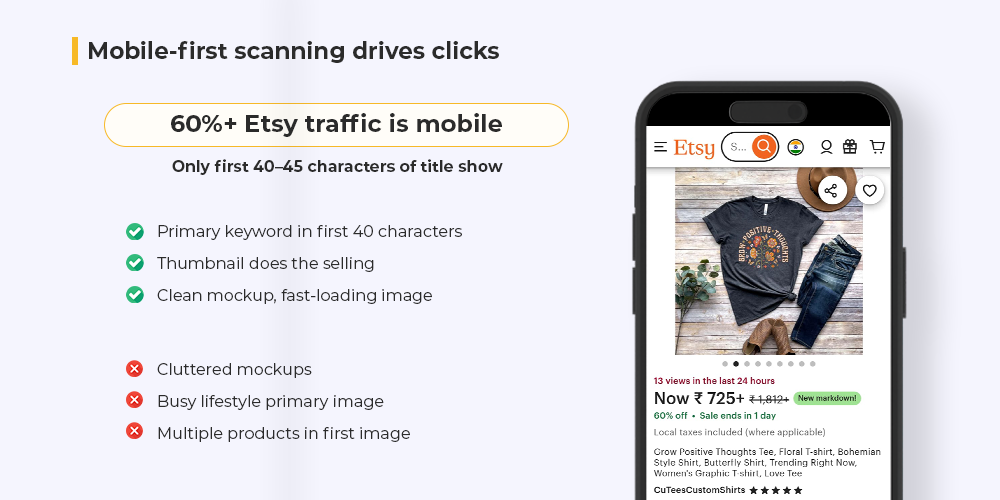
According to Etsy, over 60% of traffic now comes from mobile devices, and listings are evaluated continuously based on how real buyers interact with them.
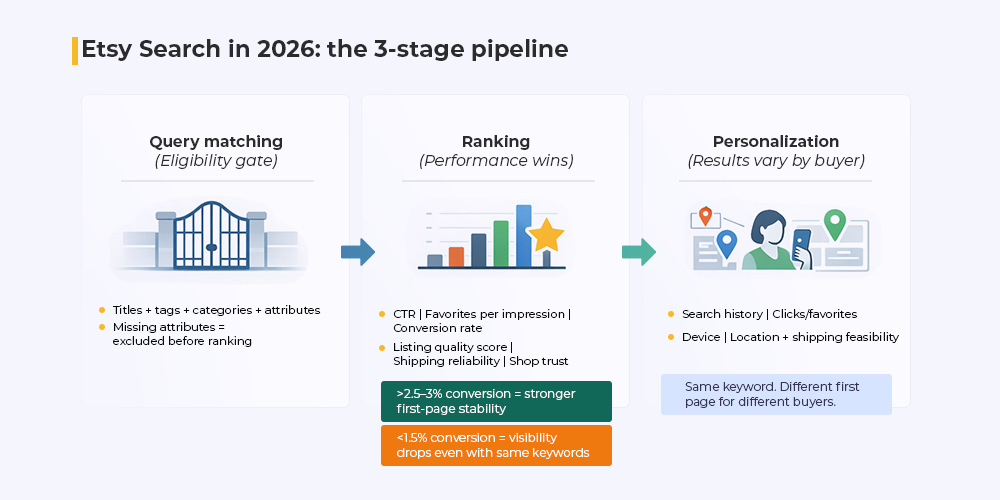
Etsy search in 2026 operates on a three-stage pipeline:
Internal Etsy seller updates indicate that listings with conversion rates above 2.5–3% are significantly more likely to hold first-page positions than listings below 1.5%, even if keywords are identical.
Implication for Etsy sellers: Two buyers can search the same keyword and see completely different first-page results. Etsy SEO 2026 gets you into the pool, while performance keeps you visible.
Keyword research now is about identifying the highest-intent keyword you can realistically rank for. Using at least two online tools together helps avoid false positives caused by estimated data.
You can also opt for CedCommerce’s Managed Marketing Services for data led strategies to improve your chances.
Long-tail keywords enable Etsy success in 2026.
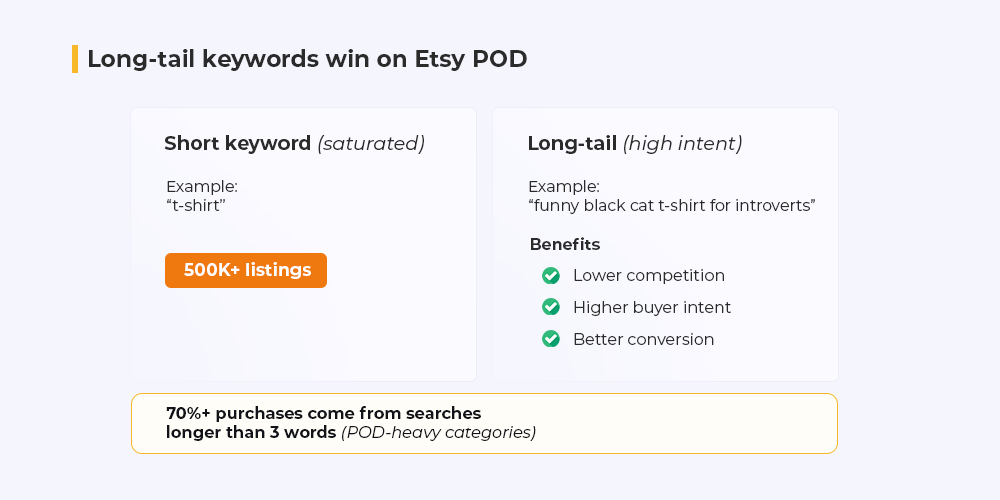
Online data shows that 70%+ of Etsy purchases happen on searches longer than three words, especially in Print-On-Demand categories like apparel, gifts, and home décor.
Example:
Every keyword falls into one of three intents:
Your primary keyword should always be transactional.
Rule of thumb:
If the top results are mostly:
Once keywords are chosen, how you deploy them determines ranking stability.
Best-performing structure: Primary keyword + clarifier + use case
Focus on:
You can also opt for CedCommerce’s Managed Marketing Services for data led strategies to boost your visibility and ranking.
Attributes act as hidden tags. Hence, missing attributes = lost search eligibility.
For Etsy SEO for print-on-demand in 2026:
Avoid:
Alt text supports:
Best practice:
Example: “Unisex cotton POD t-shirt with minimalist mountain design in black”
Pricing is where most Etsy POD sellers quietly fail, because prices don’t reflect true costs, buyer psychology, or Etsy’s fee structure. In 2026, profitable POD pricing is led by sustaining conversion.
Before setting a price, you must know your real per-unit cost. For most POD sellers, this includes:
Rule of thumb: If your all-in cost is $12, pricing below $22–$24 leaves little room for profit after ads and refunds.
There is no single “best” pricing model but these three consistently work for Print-On-Demand sellers.
Price = total cost + fixed margin (e.g., 40–60%).
Best for: Standard tees, mugs, entry-level products.
Price based on perceived value, not cost.
Best for: Personalized gifts, trend-led designs, micro-niches.
Offer:
Key Insight: Tiered pricing can lift AOV by 20–30% without increasing traffic.
Best for: Apparel, wall art, bundles.
Small pricing decisions have outsized impact on conversion.
Prices ending in .99 or .95 still outperform round numbers on Etsy, especially under $50.
Example: $24.99 converts better than $25.
Display a higher “compare at” price (where allowed) to establish value. Used correctly, anchors improve conversion by 10–15% in gift categories.
Bundling 2–3 related items:
Etsy continues to favor free shipping psychologically, even if SEO impact is neutral.
Best practice:
Key takeaway:
Profitable POD pricing is a success when you know your costs, choose the right model, and use psychology to protect margin. For a complete step-by-step foundation (from setup to first sales) refer back to the main Etsy POD pillar guide.
Your POD supplier directly impacts product quality, delivery speed, customer reviews, and repeat purchases. In 2026, choosing the right partner is less about who is “cheapest” and more about who supports your growth model.
| Factor | Printful | Printify | Gelato |
|---|---|---|---|
| Product catalog | Moderate but curated | Very large (multiple providers) | Smaller but focused |
| Quality consistency | High and uniform | Varies by print provider | High and consistent |
| Pricing | Higher base cost | Flexible, often lower | Mid-range |
| Global fulfillment | US, EU, limited APAC | Depends on provider | Strong global network (30+ countries) |
| Branding options | Custom labels, pack-ins, branding inserts | Limited branding | Limited but clean packaging |
Shops using localized fulfillment (EU-to-EU, US-to-US) report 15–25% fewer delivery complaints compared to cross-border shipping.
There is no universal “best” POD supplier. The right choice depends on brand positioning, margins, and operational goals.
Listings with delivery estimates under 7 days tend to convert better in gift and apparel categories.
All three platforms offer native Etsy integrations. The setup process is similar across providers.
Step-by-step integration setup:
Before scaling:
Data point:
Sellers who skip test orders face 2–3× higher refund rates during their first 30 days.
Key takeaway:
Your POD supplier is part of your brand experience. Choose based on quality, delivery reliability, and scale readiness.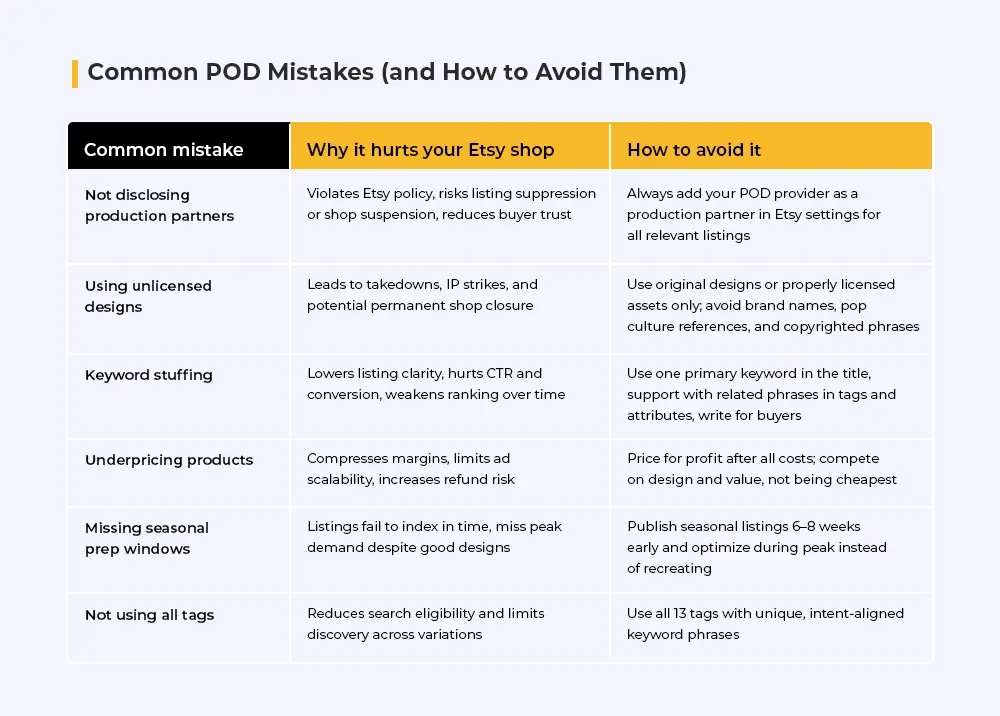
Manual workflows break long before demand does. Most Etsy POD sellers hit an operational ceiling around 50–100 listings, because listing creation, updates, pricing, and order handling don’t scale manually.
In 2026, scalable POD growth depends on automation first, expansion second.
Automation frees up time for what actually drives revenue: design, testing, and marketing.
Key automation areas for POD sellers:
Why this matters:
Sellers using bulk and mockup automation can launch 3–5× more listings per week than manual workflows, directly increasing surface area for discovery.
Etsy is excellent for discovery, but limited when it comes to ownership, remarketing, and long-term retention. High-growth POD sellers in 2026 build a multi-channel ecosystem.
A common and proven growth path:
Pinterest plays a unique role for POD:
With CedCommerce, sellers can create Pinterest-ready product Pins directly from Etsy listings, reducing manual work and keeping product data consistent across channels.
As complexity grows, sellers need a single control layer across channels.
CedCommerce enables scale by providing:
Instead of rebuilding workflows per platform, sellers operate from one system.
Reaching 200+ listings is less about speed and more about structure.
Effective scaling strategies:
Reality check:
Shops that scale sustainably usually take 3–6 months to reach 200+ listings with stable conversion.
Key takeaway:
Scaling Etsy POD is achieved by systemizing operations and expanding channels intelligently.
Explore the Etsy Integration for Shopify by CedCommerce
Seasonality is not optional on Etsy, it’s the single biggest revenue accelerator, especially for POD sellers. Q4 alone can account for 40–50% of annual Etsy revenue for well-prepared shops.
Looking ahead to 2026, winning Etsy POD sellers will:
With automation and multi-channel support, seasonal preparation becomes repeatable, predictable, and scalable.
Q4 (October–December) drives:
Key Etsy moments:
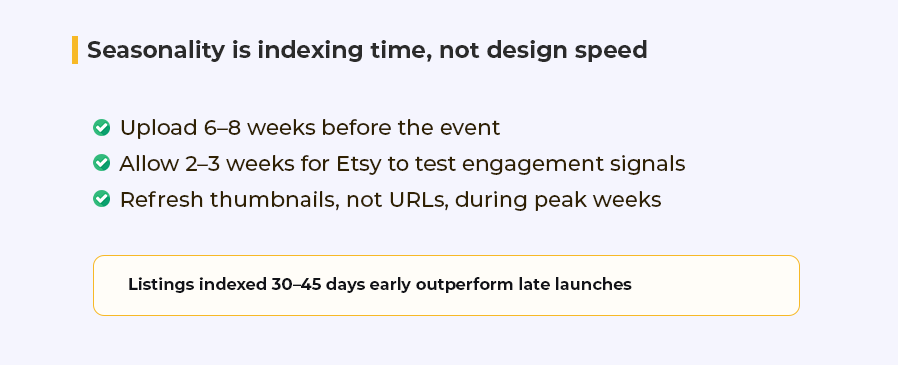
Listings published and indexed 30–45 days before peak demand perform significantly better than late launches, even with identical designs.
Seasonal success on Etsy is about indexing time, not design speed.
Best-practice timing:
Avoid:
Seasonal keywords evolve every year.
Effective strategies:
Example: “Christmas gift for dog moms”
Long-tail holiday keywords convert better than generic terms, especially in POD gift categories.
Great designs don’t sell themselves. Layered marketing is what works; combining on-platform ads, off-platform discovery, and retention workflows. The goal isn’t traffic at any cost, but profitable, repeatable demand.
Etsy Ads work best after a listing has organic traction.
When to start
Budget allocation
ROAS measurement
For sellers managing ads across multiple listings or shops, CedCommerce’s Etsy managed marketing services can help optimize spend, keywords, and listing selection, especially useful when scaling beyond manual control.
Pinterest remains one of the most underrated traffic channels for Etsy POD.
Why Pinterest works
Visual SEO
Traffic automation
With CedCommerce, sellers can generate Pinterest-ready Pins directly from Etsy listings, turning each product into an evergreen traffic asset without designing from scratch.
Short-form video drives awareness, not immediate conversions.
What works
UGC strategies
Consistency matters more than virality.
Post-purchase email lists
Repeat customer workflows
Repeat buyers convert 2–3× better than first-time customers and are less price-sensitive.
Measuring the right data and operating within Etsy’s compliance boundaries: two things most new sellers overlook! Growth without visibility leads to wasted effort, and growth without compliance puts the entire shop at risk.
Etsy provides enough data to guide decisions if you know what to focus on. Key Etsy Shop Stats to monitor weekly:
Listings with CTR below 1% usually need thumbnail or title changes. Conversion rates above 2.5–3% signal products ready for ads or scaling.
Native Etsy data shows what is happening. Use free tools to:
Small changes drive outsized results when tested methodically. Focus on:
Test one variable at a time, track results for 7–14 days, and scale only proven improvements.
Compliance is not optional in 2026.
Key takeaway:
Sustainable Etsy POD growth happens at the intersection of data-driven optimization and strict compliance. Measure what matters, test intelligently, and operate transparently, so your growth compounds instead of resets.
Etsy POD success in 2026 is built on strong SEO, profitable pricing, reliable fulfillment, consistent marketing, and strict compliance. Most sellers see meaningful traction within 3–6 months when systems are in place, with healthy POD businesses targeting 40–60% gross margins. Seasonal success depends on preparation, publish listings 6–8 weeks early and optimize, not recreate, during peak demand.
To scale without operational friction, automation and multi-channel control are essential.
Take Your Etsy POD Business to the Next Level with CedCommerce: leverage accurate sync, faster listing workflows, Etsy marketing support, and seamless multi-channel scaling.


Reading Time: 2 minutes A new industry study shows that agentic commerce is moving from…

Reading Time: 2 minutes Amazon has introduced new 1-hour and 3-hour delivery options for customers…
Reading Time: 16 minutes How to find, quantify, and validate winning Amazon products? Amazon product…
Reading Time: 2 minutes Amazon is rolling out a significant update that will directly impact…
Reading Time: 3 minutes Ulta Beauty is preparing to launch a curated storefront on TikTok…
Reading Time: 2 minutes Until now, falling below the 90% OTDR (On-time Delivery Requirement) could…
Reading Time: 5 minutes Amazon has formally expanded its Multi-Channel Fulfillment (MCF) operations in Europe…
Reading Time: 4 minutes Amazon has announced that Sponsored Products prompts and Sponsored Brands prompts…
Reading Time: 4 minutes Amazon has expanded access to its healthcare-focused AI assistant, Health AI,…
Reading Time: 4 minutes Amazon has officially launched its Spring Deal Days shopping event, offering…

Reading Time: 4 minutes eBay UK has announced a new partnership with global embedded finance…
Reading Time: 4 minutes TikTok Shop has officially launched its first-ever Fine Art category, marking…
Reading Time: 2 minutes eBay has temporarily paused international sales from the United States to…
Reading Time: 3 minutes Walmart Marketplace has expanded its Review Accelerator program with a new…
Reading Time: 3 minutes A significant policy change is coming to Amazon Wish Lists that…
Reading Time: 3 minutes A major shift is emerging in how Gen Z discovers and…
Reading Time: 4 minutes Social commerce is no longer confined to the platform where discovery…

Reading Time: 3 minutes eBay has released its U.S. 2026 Marketing Trends Calendar, a data-backed…
Reading Time: 4 minutes U.S. eCommerce is entering a new phase of structural expansion, with…
Reading Time: 4 minutes eBay has introduced on-site tracking support for orders delivered through seller-owned…